

| TL;DR Understanding the difference between an NHS vs private prescription UK service helps you manage healthcare costs. While NHS prescriptions offer fixed prices, private options provide faster access to specialised medications. |
Are you wondering whether to use an NHS or a private service for your medication? For many residents in Cleckheaton and West Yorkshire, accessing the right medication quickly and affordably is a top priority. When considering the benefits of an NHS vs private prescription UK patients often have questions about the costs, the rules, and whether one system is better than the other.
Getting a prescription can sometimes feel complicated. You might see a private specialist to skip a waiting list, only to be surprised by the cost of the medicine at the pharmacy counter.
At Cleckheaton Pharmacy, we dispense both types of medication every day. In this helpful guide, we will explain the differences between NHS and private prescriptions, how the pricing works, and how to decide which route is right for your healthcare needs.
What Is an NHS Prescription?
An NHS prescription is issued by a healthcare professional working within the National Health Service. This includes your local GP, an NHS hospital doctor, or even a specially trained pharmacist. The primary benefit of this system is that the government subsidises the cost of the medication.
When you bring this type of prescription to a pharmacy, you only pay a standard fixed fee per item, regardless of how much the drug actually costs to manufacture. In England, the current charge is a flat rate. Furthermore, many people qualify for free medications based on their age, income, or specific medical conditions. You can check the official NHS guidance on prescription charges to see if you are exempt from paying.
If you regularly use this service, you can nominate a pharmacy to handle your repeat medications automatically. Our NHS Prescription Dispensing service allows patients to collect their regular treatments conveniently and safely.
What Is a Private Prescription?
A private prescription is issued when you see a doctor or specialist outside of the NHS system. This could be at a private hospital, a dedicated wellness clinic, or through an online medical consultation.
Because these consultations are not funded by the government, the medication is not subsidised. When you use a private prescription, you must pay the full retail cost of the medicine yourself, alongside a small dispensing fee charged by the pharmacy to cover their professional time.
Many patients choose private healthcare because it offers faster access to specialists. It also allows doctors to prescribe medications that might not be routinely available or approved yet on the local NHS formulary. Examples include specific travel vaccines, certain weight loss treatments, or specialist dermatology creams.
The Main Differences to Consider
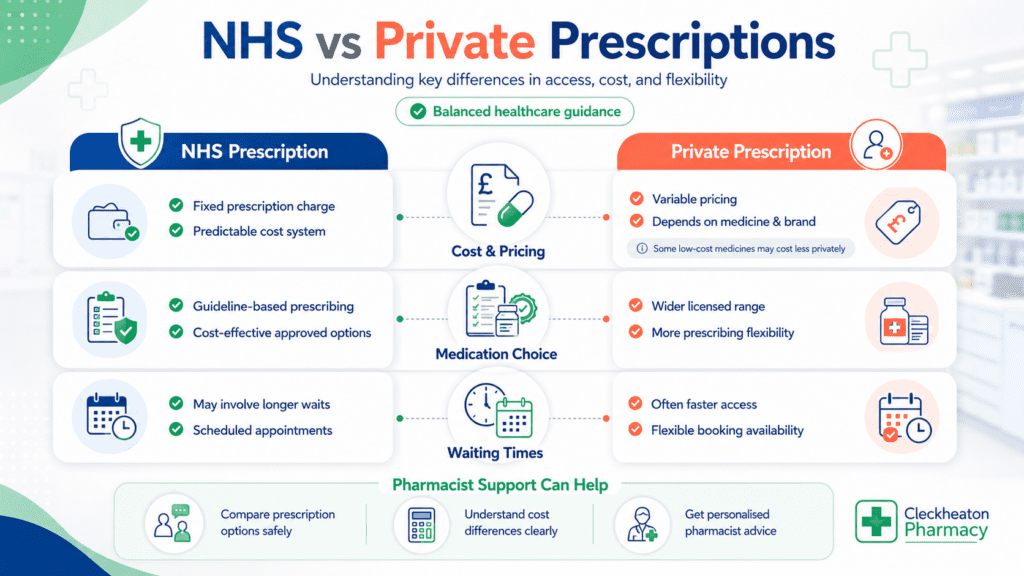
Understanding the main differences can help you make an informed choice about your health.
Cost and Pricing
NHS prescriptions have a fixed price per item, making them highly predictable and affordable for complex or expensive drugs. Private prescription costs, on the other hand, vary wildly depending on the exact drug, the brand, and the pharmacy dispensing it. Interestingly, if a medication is very cheap to buy, a private prescription might occasionally cost less than the fixed NHS fee.
Choice of Medication
The NHS has a strict list of approved medicines. Doctors must follow these local guidelines to ensure cost effective care. Private doctors have more flexibility. They can prescribe a wider range of licensed medicines, giving you more choices if standard NHS treatments have not worked for you.
Waiting Times
Getting an NHS appointment can sometimes take longer, delaying your access to treatment. Private doctors usually offer faster appointments, meaning you get your medication sooner. This speed is often the main reason patients choose to pay for private healthcare.
Can You Convert a Private Prescription to an NHS One?
This is a very common question at the pharmacy counter. If you have paid to see a private doctor and they have given you a prescription, you might want to ask your regular GP to rewrite it on the NHS to save money.
Sometimes, your GP will agree to do this. However, they are under no obligation to do so. They may refuse to convert your private prescription if:
- The medicine is blacklisted and not allowed on the NHS.
- The treatment is not part of the standard local clinical pathway.
- The medicine requires complex monitoring by a hospital specialist.
- They simply disagree with the private doctor’s choice of treatment.
If your GP cannot rewrite the prescription, you will need to pay for it privately. If you are struggling with ongoing medicine costs, you should review the NHSBSA advice on help with health costs to see what support might be available.
Faster Access at Your Local Pharmacy
You do not always need to see a doctor to get a prescription. Pharmacists can now provide a lot of the care you need directly.
Through the NHS Pharmacy First scheme, our highly trained pharmacists can supply prescription only medicines for seven common conditions, including earaches, sore throats, and uncomplicated urinary tract infections. This bypasses the need for a GP appointment entirely.
We also offer comprehensive NHS Health advice and Self care support to help you manage minor ailments safely at home without needing a formal prescription.
If you live in Cleckheaton, Bradford, Batley, Birkenshaw, Liversedge, Heckmondwike, or nearby areas, Cleckheaton Pharmacy can help you access trusted pharmacy advice and convenient local care.
Closing
When comparing an NHS vs private prescription UK system, the best choice depends on your specific circumstances. NHS prescriptions offer affordable, subsidised care for routine conditions. Private prescriptions provide speed and flexibility, allowing access to treatments that might not be available on the standard health service.
Whether you are dropping off an NHS repeat form or presenting a private letter from a specialist, our professional pharmacy team is here to dispense your medication safely. If you have any questions about the cost or availability of your medicine, speak to our pharmacist today.
Frequently Asked Questions
How much is an NHS prescription charge?
The NHS prescription charge is a fixed fee per item in England. This fee helps fund the NHS. Some people, including those over 60, under 16, or with specific medical exemptions, do not have to pay this charge at all.
Is a private prescription always more expensive?
No, it is not always more expensive. If the actual cost of the medicine is very low, buying it privately might cost less than the standard fixed NHS charge. However, for most modern medicines, paying the full retail price plus a dispensing fee makes it more expensive.
Can I get an NHS prescription from a private doctor?
No, you cannot. Private doctors and clinics cannot issue NHS prescriptions. Any medication prescribed during a private consultation will be written on a private prescription, meaning you must pay the full cost of the medicine yourself at the pharmacy.
Can my NHS GP rewrite my private prescription?
Yes, sometimes they can. Your GP may agree to convert your private prescription to an NHS one if the medicine is approved by your local NHS treatment pathway. However, they can legally refuse if the drug is blacklisted or requires specialist monitoring.
How long is a prescription valid for in the UK?
A standard prescription is usually valid for six months from the date it was signed. This applies to both standard NHS and private prescriptions. However, prescriptions for certain controlled drugs are strictly valid for only 28 days to ensure patient safety.