
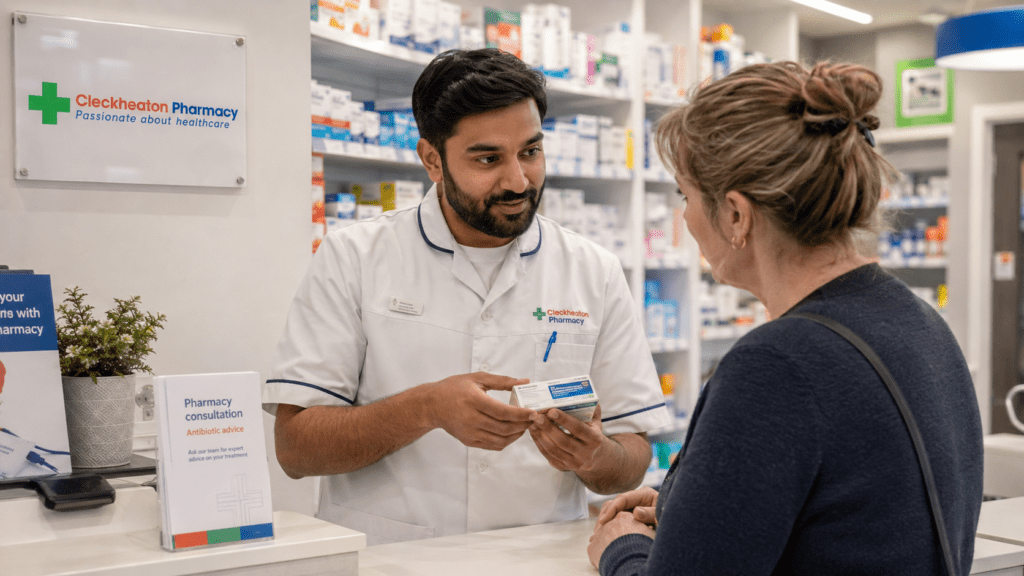
| TL;DR To understand can a pharmacist prescribe antibiotics, you should explore the NHS Pharmacy First service. Pharmacists can now provide antibiotics for seven common conditions without needing a prior GP appointment. |
For generations, the standard path to receiving antibiotics in the United Kingdom involved waiting days for a GP appointment, sitting in a crowded waiting room, and finally heading to the chemist with a paper or electronic script. However, as healthcare evolves to become more accessible, many residents in Cleckheaton and West Yorkshire are asking a vital question: can a pharmacist prescribe antibiotics directly?
The short answer is yes, but with specific conditions. Thanks to recent shifts in NHS policy and the introduction of the Pharmacy First service, community pharmacists have taken on a more clinical role. This change is designed to provide you with faster access to care while easing the pressure on local doctors.
In this guide, we will explain exactly how the process works at Cleckheaton Pharmacy, which illnesses are covered, and what you can expect during a clinical consultation on Market Street.
The Role of the Modern Pharmacist
Pharmacists are highly trained healthcare professionals who study for five years to understand the complexities of medicines. While they have always been experts in how drugs interact and work within the body, their ability to “prescribe” or supply prescription-only medicines (POMs) has historically been limited.
Today, the landscape is different. Under a framework called Patient Group Directions (PGDs), pharmacists can now supply certain antibiotics for specific conditions without you needing to see a doctor first. This does not mean pharmacists can hand out antibiotics for any illness; rather, they follow strict clinical protocols to ensure that antibiotics are used responsibly to prevent antimicrobial resistance.
What is the NHS Pharmacy First Service?
Launched to make healthcare more convenient, the NHS Pharmacy First service is a game-changer for local communities. Through this scheme, our team at Cleckheaton Pharmacy can assess and treat seven specific minor ailments. If the pharmacist determines that your condition is bacterial and requires treatment, they can supply the necessary medication on the spot.
The Seven Conditions Covered
The NHS has selected these seven conditions because they are common and can be safely diagnosed by a pharmacist in a consultation room:
- Sinusitis: For patients aged 12 years and over.
- Sore Throat: For patients aged 5 years and over.
- Earache (Acute Otitis Media): For children and young people aged 1 to 17 years.
- Infected Insect Bites: For patients aged 1 year and over.
- Impetigo: A contagious skin infection, treated for those aged 1 year and over.
- Shingles: For adults aged 18 years and over.
- Uncomplicated Urinary Tract Infections (UTIs): For women aged 16 to 64.
If you are suffering from symptoms of these conditions, you can walk into our pharmacy or be referred by NHS 111. Our NHS Pharmacy First service ensures you get the right help at the right time.
How the Consultation Process Works
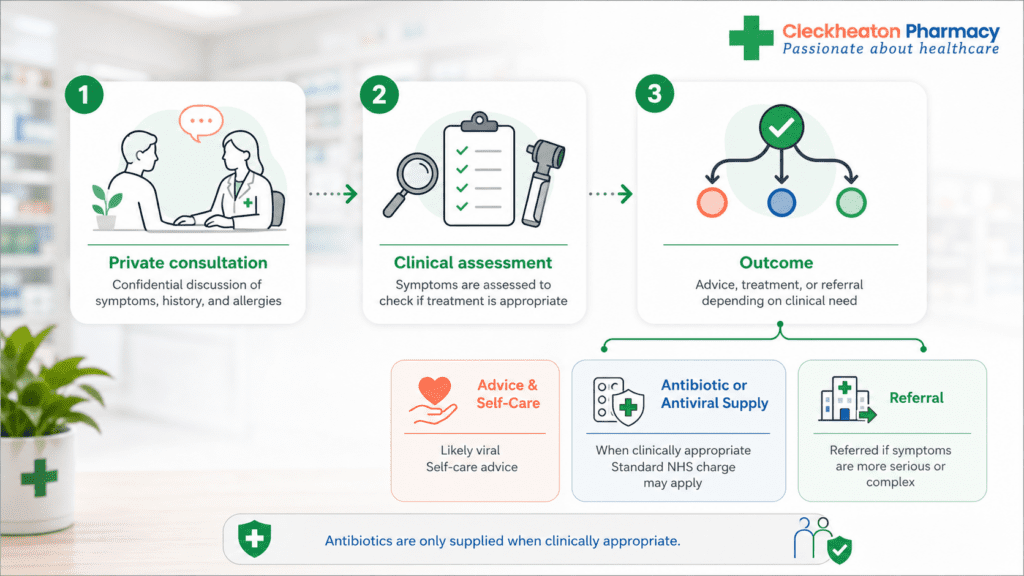
When you visit us, wondering can a pharmacist prescribe antibiotics for your symptoms, we don’t just hand over a box of pills. We conduct a professional clinical consultation to ensure antibiotics are actually necessary.
1. The Private Consultation
We will invite you into our private consultation room to discuss your symptoms. This is a confidential space where you can speak freely, just as you would with a GP. We will ask about the duration of your symptoms, your medical history, and any allergies you may have.
2. Clinical Assessment
Our pharmacists may perform a physical check. For example, if you have a sore throat, we might look for swelling or white spots. If you have an earache, we may use an otoscope to look inside the ear. This helps us distinguish between a viral infection (which antibiotics cannot treat) and a bacterial one.
3. The Outcome
There are three likely outcomes from your Pharmacy First consultation:
- Advice and Self-Care: We may explain that your infection is likely viral and recommend over-the-counter treatments to manage pain or fever.
- Antibiotic or Antiviral Supply: If the clinical criteria are met, we will supply the medication. You will pay the standard NHS prescription charge unless you are exempt.
- Referral: If your symptoms are severe or suggest a more complex issue, we will refer you to your GP or an Urgent Care Centre.
Why Antibiotics Aren’t Always the Answer
A common misconception is that every cough or cold requires a “strong” course of antibiotics. However, UKHSA advice on flu vaccination and respiratory health highlights that most winter bugs are viral.
Antibiotics only work against bacteria. Using them for viral infections like the flu or most common colds is not only ineffective but can lead to side effects like stomach upset or thrush. More importantly, it contributes to antibiotic resistance, making these life-saving drugs less effective for everyone in the future.
At Cleckheaton Pharmacy, we pride ourselves on being “Antibiotic Guardians.” If we advise against antibiotics, it is because we are following the latest clinical evidence to keep you safe.
Beyond Antibiotics: Other Pharmacy Services
While many people visit us specifically asking can a pharmacist prescribe antibiotics, our expertise covers a much broader range of healthcare needs. We aim to be a one-stop-shop for the Cleckheaton community.
- Vaccinations: We offer a wide range of protection, from seasonal flu jabs to travel vaccinations for those heading abroad.
- Weight Management: For those looking to improve their long-term health, our weight loss support service provides professional guidance and clinical options.
- Emergency Care: If you have run out of your regular medication, we can often assist with emergency supplies to ensure your treatment is not interrupted.
When to Seek Urgent Medical Help
While we can treat many conditions, certain “red flag” symptoms require immediate medical attention. You should contact NHS 111, your GP, or call 999 if you experience:
- Difficulty breathing or severe chest pain.
- A rash that does not fade when a glass is pressed against it.
- Sudden confusion or slurred speech.
- Severe swelling of the face, lips, or tongue.
Local Pharmacy Care in West Yorkshire!
If you live in Cleckheaton, Bradford, Batley, Birkenshaw, Liversedge, Heckmondwike, or nearby areas, Cleckheaton Pharmacy can help you access trusted pharmacy advice and convenient local care. Our doors are open on Market Street to support your family’s health without the need for a long wait.
Summary of the Service
In summary, the question of whether a pharmacist can prescribe antibiotics is no longer a simple “no.” For seven specific, common conditions, your local pharmacist is now empowered to be your first point of clinical contact. This service is free, professional, and accessible.
By choosing to visit the pharmacy first for minor ailments, you are helping the NHS manage its resources more effectively while getting the treatment you need faster.
Frequently Asked Questions
Which antibiotics can a pharmacist give me?
The specific antibiotics a pharmacist can supply depend on the condition being treated and the NHS protocols (PGDs) in place. For example, for a urinary tract infection, a pharmacist might supply nitrofurantoin or trimethoprim. For a skin infection like impetigo, they may provide a topical cream like fusidic acid or an oral antibiotic like flucloxacillin. The choice is based entirely on clinical guidelines and your specific health needs.
Do I need to book an appointment for Pharmacy First?
At Cleckheaton Pharmacy, you do not usually need an appointment to access the Pharmacy First service. You can simply walk in and ask to speak with the pharmacist about your symptoms. While there might be a short wait if the pharmacist is already in a consultation, we aim to see you as quickly as possible, often much faster than waiting for a GP slot.
Will I have to pay for the antibiotics?
The consultation itself is entirely free of charge. If the pharmacist decides that you need antibiotics and they are supplied through the NHS Pharmacy First scheme, the standard NHS prescription charge will apply. If you usually get free prescriptions (for example, if you are over 60, under 16, or have a valid exemption certificate), the medication will be free.
Can a pharmacist prescribe antibiotics for a tooth infection?
Currently, dental infections are not included in the seven conditions covered by the NHS Pharmacy First service. If you have a dental abscess or a toothache that you suspect is infected, you should contact your dentist. If you do not have a dentist, you can call NHS 111 to be directed to an emergency dental service. Pharmacists can, however, provide pain relief advice for dental pain.
Can a pharmacist prescribe for my child?
Yes, pharmacists can treat children for several conditions under the Pharmacy First scheme. This includes earaches for children aged 1 to 17, sore throats for those aged 5 and over, and impetigo or infected insect bites for those aged 1 and over. A parent or guardian should accompany the child to the consultation so the pharmacist can accurately assess the symptoms and medical history.