
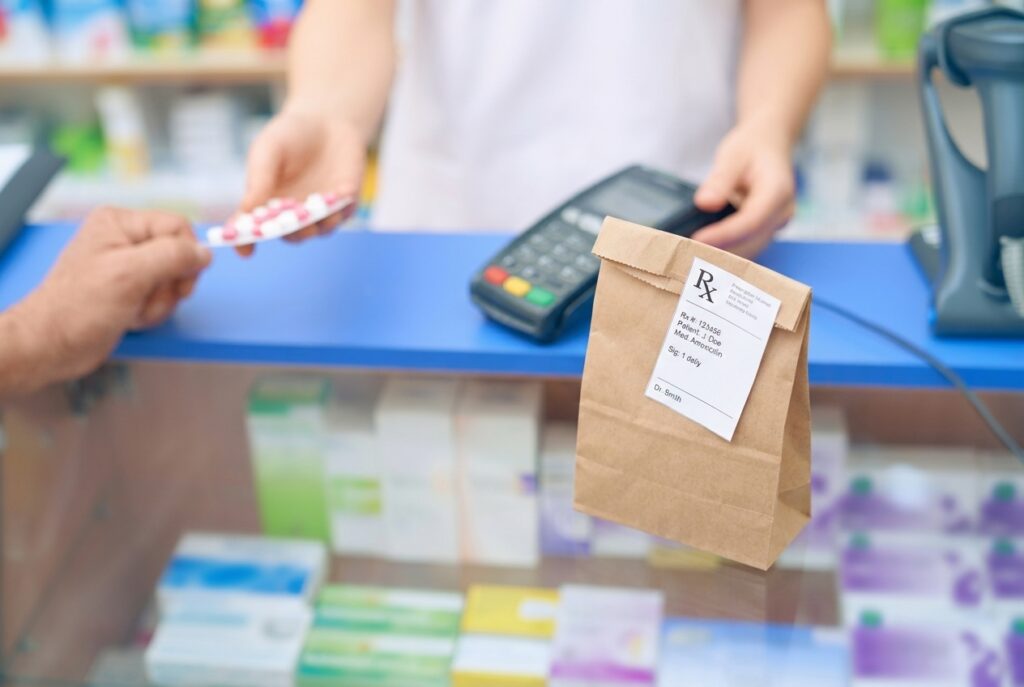
| TL;DR National Health Service prescriptions are sent electronically to your chosen pharmacy, often ready the same day. You usually pay a standard fee per item, but many people qualify for free prescriptions. Pharmacists check, prepare, and safely dispense your medication with advice. Using a nominated pharmacy makes repeats faster, easier, and more convenient. |
Most people in the UK collect an NHS prescription at least once a year, but the process behind it is not always clear. From how your prescription reaches the pharmacy to what happens during dispensing, there are several steps involved in ensuring your medication is safe, accurate, and ready on time. Understanding this journey helps set the right expectations around timing, costs, and collection.
At Cleckheaton Pharmacy, we dispense thousands of NHS prescriptions every month with a focus on safety, efficiency, and patient care. This guide explains each stage of the dispensing process, from when your GP issues the prescription to when you collect your medication, so you know exactly what to expect and how to make the most of the service.
How NHS Prescriptions Work: The Basics
An NHS prescription is a legal document authorising a pharmacy to dispense a specific medication or medical product to a named patient, at a cost partially or fully subsidised by the National Health Service. In 2024/25, the standard NHS prescription charge is £9.90 per item, meaning each different medication on your prescription costs £9.90 to collect.
However, the majority of NHS prescriptions in England are collected free of charge. Around 89% of NHS prescription items are dispensed without a payment, because the patient either qualifies for an exemption or because the medication is exempt from the charge itself (such as all prescriptions dispensed to patients in Wales and Scotland, where charges have been abolished).
The Electronic Prescription Service (EPS): How Your Prescription Gets to Us
The vast majority of NHS prescriptions in England are now sent electronically through the Electronic Prescription Service (EPS). Paper prescriptions, the green FP10 forms you may remember, are now relatively rare, reserved for certain clinical situations, controlled drug prescriptions, and prescriptions issued during home visits.
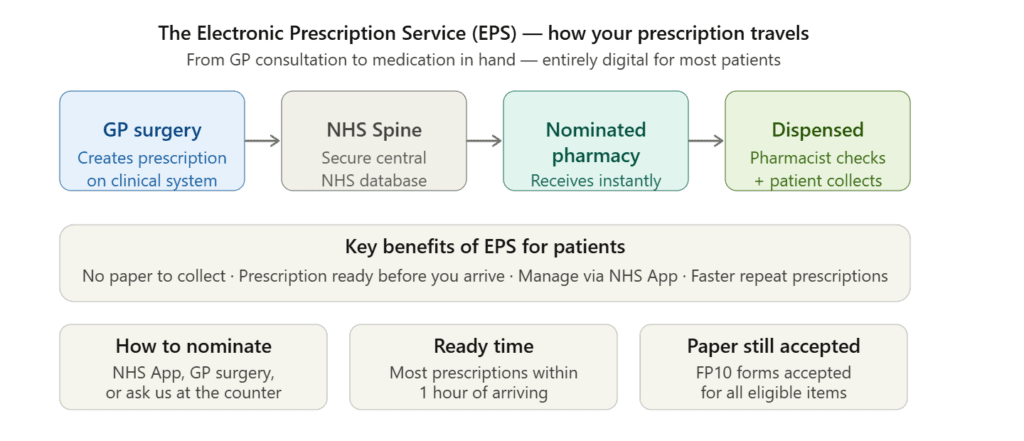
Here is how EPS works:
Your GP (or other prescriber) creates your prescription on their clinical software. This generates a digital prescription record linked to your NHS number.
The prescription is sent electronically directly to your nominated pharmacy. If you have not nominated a pharmacy, you will receive a paper token or a message directing you to choose one. At Cleckheaton Pharmacy, you can nominate us as your preferred pharmacy through your GP surgery, the NHS App, or by asking us directly.
We receive it automatically. Your prescription appears in our dispensing system, usually within minutes of your GP sending it, sometimes before you have even left the surgery.
We prepare your medication. Our dispensing team assembles your prescription, checks it for accuracy, and a pharmacist clinically verifies it, checking for correct dosing, potential drug interactions, and clinical appropriateness.
You collect when ready. We will text or call you when your prescription is ready if you have provided contact details. Otherwise, most prescriptions are ready within the hour, or the next day for special-order items.
What Is a Nominated Pharmacy and Why Does It Matter?
Nominating a pharmacy means telling the NHS which pharmacy you want your electronic prescriptions sent to. Your nomination is stored on the NHS spine (the central NHS database) and is attached to your NHS number.
Benefits of nominating Cleckheaton Pharmacy:
- Your prescriptions are sent directly to us the moment your GP approves them
- You do not need to collect a paper token or visit the surgery
- We can prepare your medication in advance of your collection
- Repeat prescriptions can be managed entirely online or through the NHS App without you needing to contact the surgery at all
- You build a relationship with a pharmacy team that knows your medication history
You can nominate a pharmacy, change your nomination, or cancel it at any time through the NHS App, at your GP surgery, or by asking us at the counter.
NHS Prescription Charges: Who Pays and Who Doesn’t
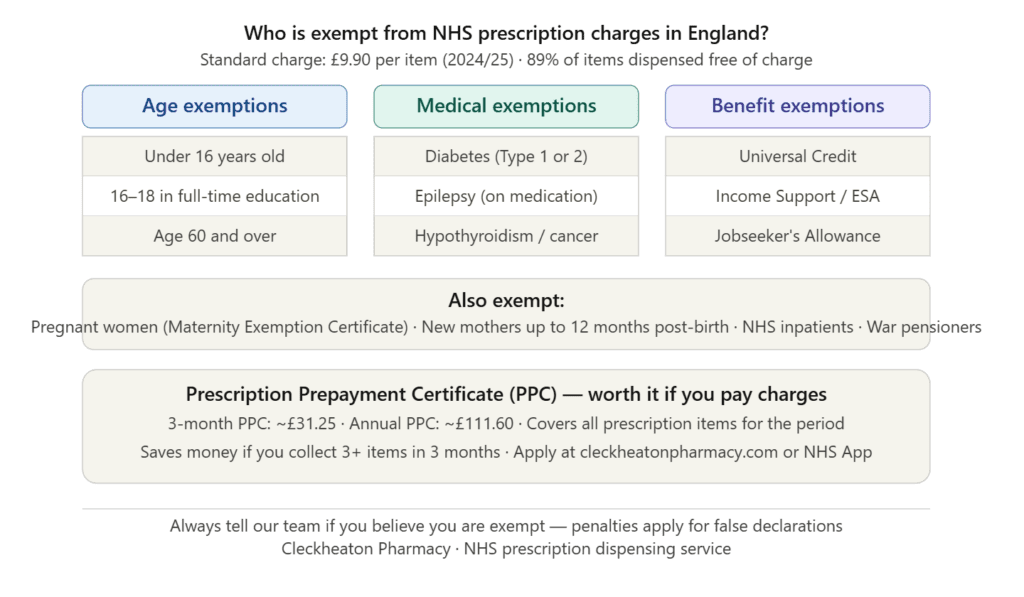
The standard charge is £9.90 per prescription item in England (2024/25). This increases each April slightly. However, if you are collecting multiple items regularly, the Prescription Prepayment Certificate (PPC) can significantly reduce your costs.
You are completely exempt from NHS prescription charges if you are:
- Aged 60 or over
- Under 16
- Aged 16–18 and in full-time education
- Pregnant or have given birth in the past 12 months (with a valid Maternity Exemption Certificate)
- Diagnosed with certain medical conditions, including diabetes, epilepsy, hypothyroidism, Addison’s disease, hypoparathyroidism, myasthenia gravis, or cancer (with a valid Medical Exemption Certificate)
- Receiving Universal Credit, Income Support, income-related Employment and Support Allowance, or income-based Jobseeker’s Allowance
- An NHS inpatient
- Receiving a war pension for your current condition
What Happens at the Counter: Your Dispensing Experience
When you arrive at Cleckheaton Pharmacy to collect your prescription:
You tell us your name, and we locate your prescription on our system. If it arrived electronically, we may already have it prepared and waiting.
We confirm your exemption status. If you are exempt from charges, you sign the back of the prescription form (or the digital equivalent). If you are not exempt, payment is made at this point.
Your pharmacist conducts a counselling check. For new medications, your pharmacist will briefly explain what the medication is for, how to take it, what to expect, and any important side effects or interactions. For regular repeat prescriptions, this may be brief, but our team is always available to answer questions.
We provide the medication with full labelling. Every dispensed medication includes a label with your name, the medication name and strength, the dose instructions, and any relevant cautionary warnings. Patient Information Leaflets are included with all dispensed medications.
Repeat Prescriptions: How to Manage Them Efficiently
If you take regular medications for a long-term condition, you will likely have a repeat prescription authorised by your GP. This means you can reorder without a GP appointment each time.
The most efficient ways to manage repeat prescriptions at Cleckheaton Pharmacy:
NHS App: Order your repeat prescription through the NHS App. It is sent directly to your GP for authorisation and then electronically to your nominated pharmacy. No phone calls, no paper.
GP practice online portal: Most GP surgeries have their own online system for repeat prescription requests.
Ask us to manage it: At Cleckheaton Pharmacy, we can contact your GP on your behalf to request repeat prescriptions and notify you when they are ready — particularly helpful for patients with multiple regular medications.
Allow adequate lead time: NHS repeat prescriptions typically take 48–72 hours from request to being ready for collection. Request early, especially before bank holidays or if your medication needs to be ordered specially.
Special Order and Manufacturer-Direct Medications
Some medications are not held as standard stock by pharmacies and must be ordered specifically for you. This includes some specialist medications, controlled drugs not held routinely, unlicensed medications (“specials”), and some less common formulations.
At Cleckheaton Pharmacy, we can typically source most special order medications within 24–48 hours. In rare cases involving unlicensed specials manufactured to order, this may take longer. We will always advise you of expected timescales upfront.
What to Do if Your Medication is Out of Stock
Medication supply issues are a real and growing challenge across the UK pharmacy sector. If we are unable to dispense your prescription immediately due to a supply shortage:
- We will tell you honestly and explain the expected wait time
- We will contact our wholesalers and alternative suppliers to source the medication as quickly as possible
- In some cases, we can contact your GP to discuss therapeutic alternatives
- We will never substitute your medication without your prescriber’s authorisation
Transparency is something we take seriously at Cleckheaton Pharmacy. You will always be told the truth about supply, even when that truth is inconvenient.
FAQs
How do NHS prescriptions work?
Under the National Health Service, eligible patients receive subsidised or free medicines prescribed by authorised clinicians, usually dispensed at community pharmacies.
How does pharmacy dispensing work?
Pharmacy dispensing involves reviewing the prescription, checking safety, preparing medication, labelling, and providing counselling to ensure correct and safe use.
What is the dispensing process in pharmacy?
The process includes prescription validation, clinical checks, medication preparation, accuracy verification, labelling, and final handover with patient advice.
What are the 60-day dispensing rules?
Some systems allow up to a 60-day medication supply for stable patients, improving adherence and convenience. Rules vary by country and healthcare policy.