
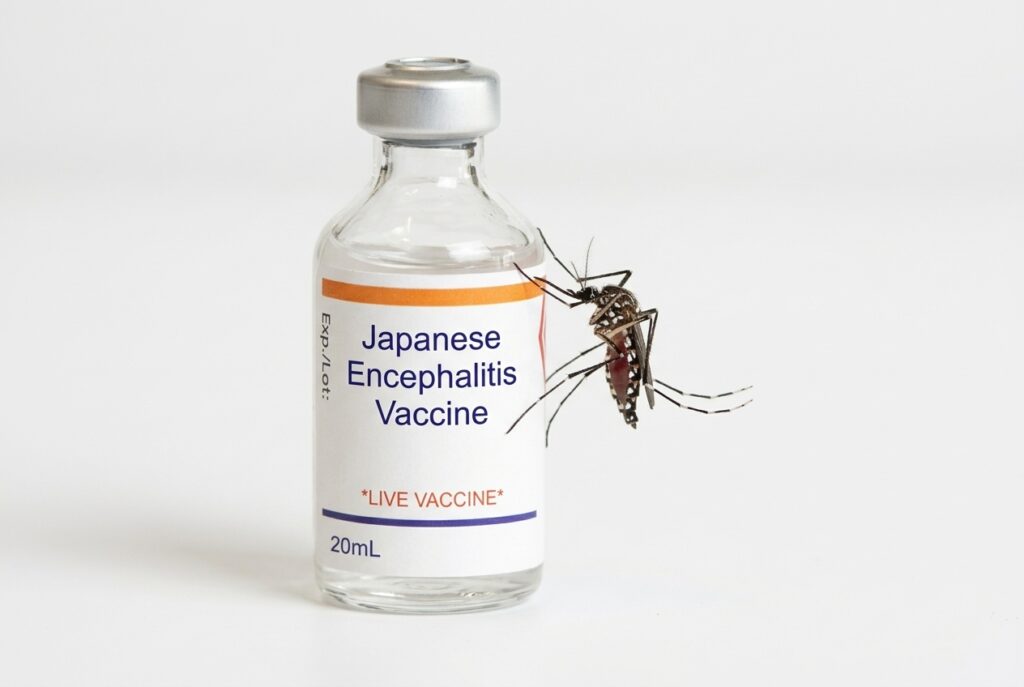
| TL;DR Japanese encephalitis is a rare but serious mosquito-borne infection in parts of Asia. Most short-term city travellers are low risk, but longer stays or rural travel increase exposure. The vaccine (IXIARO®) is highly effective and given in two doses. Cleckheaton Pharmacy offers quick, expert travel vaccination services to help you stay protected before your trip. |
Planning a trip to Southeast Asia or the Indian subcontinent? If you are, you may have come across Japanese encephalitis vaccination UK advice and wondered whether it applies to you. Most short-term city tourists are at very low risk. But for travellers heading into rural areas for a month or longer, this mosquito-borne brain infection is a genuine threat, and the vaccine is the simplest way to prevent it.
At Cleckheaton Pharmacy, we help travellers from across West Yorkshire work out exactly what protection they need before departure, so you can travel with confidence rather than guesswork.
Do you need Japanese encephalitis vaccination? A quick risk check
Most UK travellers will never catch Japanese encephalitis. According to NaTHNaC (TravelHealthPro), the infection is rare in short-term travellers, but risk rises sharply depending on where you go, what you do there, and how long you stay.
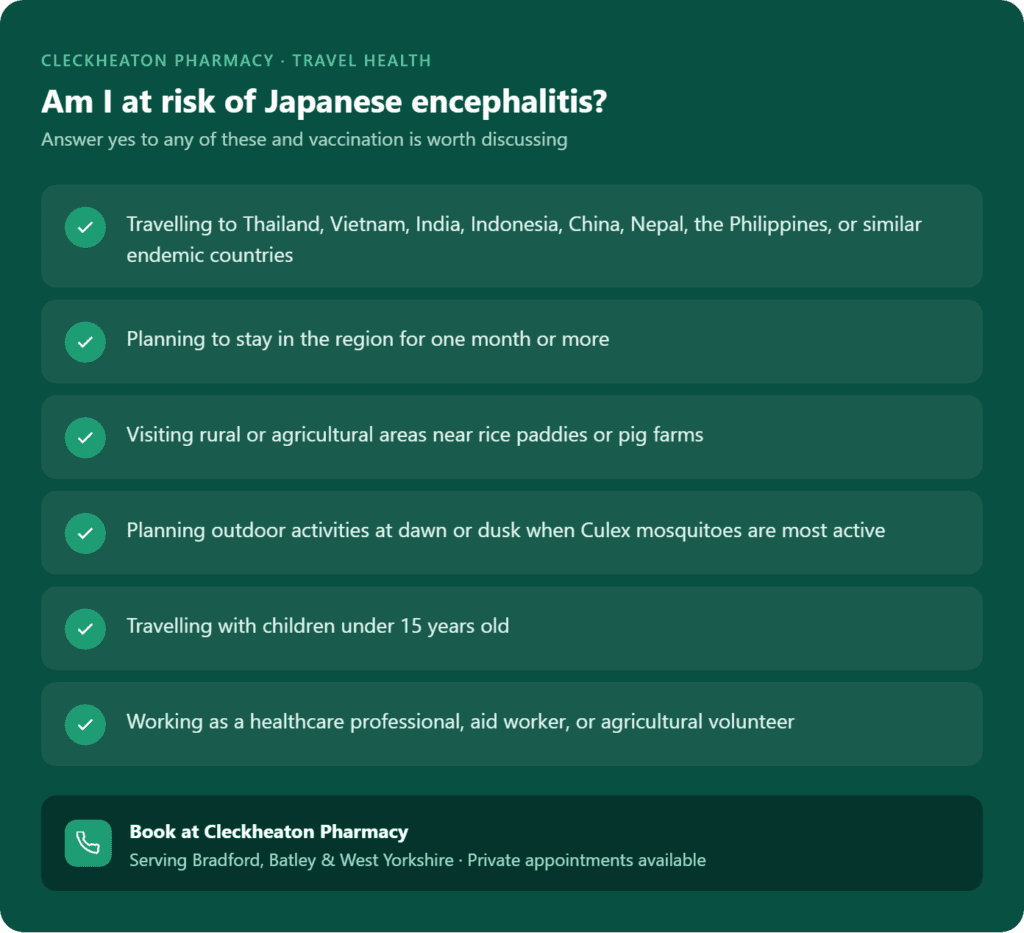
Ask yourself these questions before you decide:
- Are you travelling to an endemic country such as Thailand, Vietnam, India, Indonesia, China, Nepal, or the Philippines?
- Will you spend a month or more in the region?
- Will you visit rural or agricultural areas near rice paddies or pig farms?
- Are you planning outdoor activities at dawn or dusk?
- Are you travelling with children under 15?
- Are you working as a healthcare professional, aid worker, or agricultural volunteer?
If you answered yes to any of these, vaccination is worth discussing. If you are on a short city break to Bangkok or Hanoi with no rural excursions planned, your risk is low. That said, many travellers from Bradford and Batley who book extended family visits or volunteer placements will fall into the higher-risk category, and they are exactly who this vaccine is designed for.
Where Japanese encephalitis is found
The virus circulates in birds and pigs across much of Asia. Culex mosquitoes, which feed between dusk and dawn, transmit it to humans. Risk is higher during and after monsoon season, when mosquito populations peak. Endemic regions include East Asia, South Asia, and Southeast Asia, with sporadic cases reported as far as northern Australia.
Who faces the highest risk: long-term travellers, backpackers sleeping outdoors, families visiting rural relatives, and occupational travellers such as field researchers or healthcare volunteers. Urban tourists in modern hotels with air conditioning and window screens face considerably lower exposure.
What is Japanese encephalitis, and why does it matter?
Japanese encephalitis is a viral infection that inflames the brain. It is not spread between people. Mosquitoes pick up the virus from infected animals and pass it on through bites. According to the NHS, most people who contract it develop no symptoms or only mild fever and headache. But in a small proportion of cases, the virus crosses into the brain and causes seizures, paralysis, confusion, and in severe instances, death. Survivors of serious infection can face lasting neurological damage.
There is no specific antiviral treatment. Hospitals can only manage symptoms and support recovery. That is why the NHS advises that prevention through vaccination is the most effective approach for travellers at risk.
Symptoms to recognise:
- Mild cases produce fever, headache, nausea, and muscle ache.
- Severe cases include high temperature, stiff neck, disorientation, weakness, and seizures.
If you or someone you are travelling with develops these symptoms after spending time in an endemic area, seek emergency medical help immediately. Call 999 for severe symptoms.
The Japanese encephalitis vaccination UK schedule: two options explained
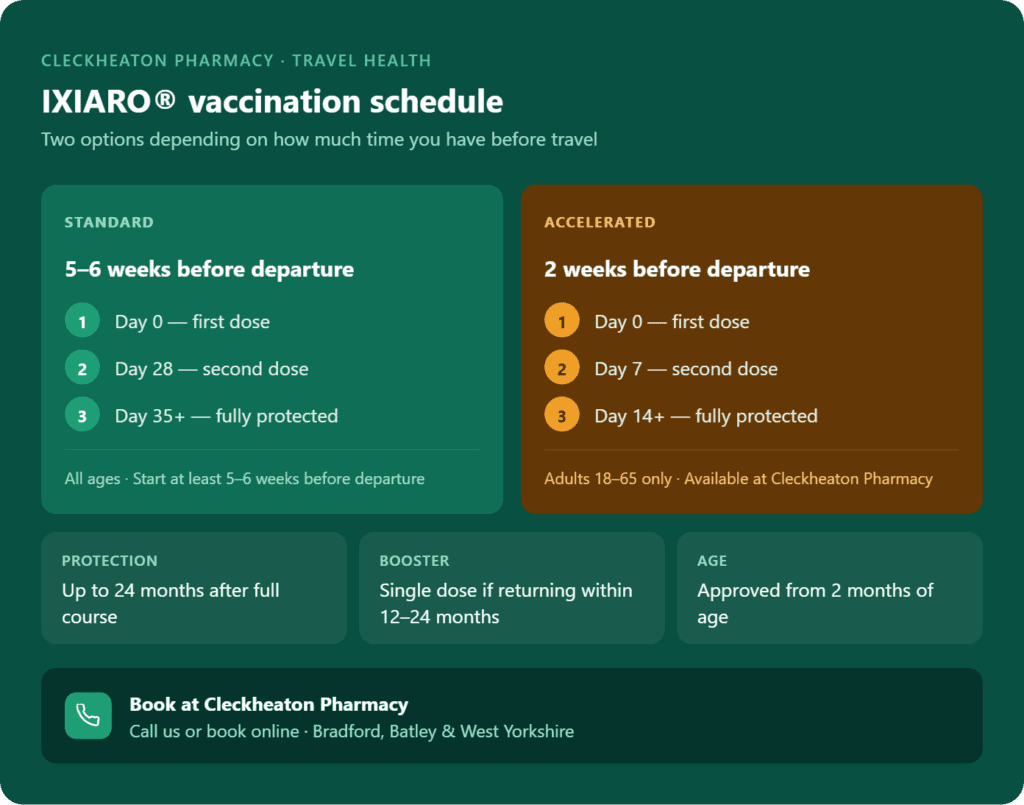
The vaccine used in the UK is IXIARO®. It provides over 90% protection after a full two-dose course. Two scheduling options are available depending on how much time you have before travel.
Standard schedule: First dose on day 0, second dose 28 days later. You need at least one week after the second dose before potential exposure. In practice, this means starting vaccination at least five to six weeks before departure.
Accelerated schedule: For adults aged 18 to 65 who are short on time, the two doses can be given seven days apart. Again, at least one week is needed after the second dose before travel. This is useful if your trip crept up or your plans changed late.
Booster: If you return to endemic areas within 12 to 24 months of your primary course, a single booster dose is recommended. After 24 months without a booster, discuss restarting the course with your pharmacist.
Age eligibility: IXIARO® is approved from two months of age. Children under three years receive a 0.25 ml dose; older children and adults receive 0.5 ml.
Side effects: Common reactions include arm soreness, mild fever, nausea, and fatigue. These typically resolve within 24 to 48 hours. Serious allergic reactions are rare.
How to book your vaccination at Cleckheaton Pharmacy
Booking is straightforward. We see travellers from across West Yorkshire regularly, including patients from Batley, Bradford, and the surrounding area who want a local option rather than travelling into a city centre clinic.
Step 1: Check your itinerary. Look up your destination on TravelHealthPro.org.uk and note your travel dates and planned activities.
Step 2: Contact us. Call Cleckheaton Pharmacy or book online to discuss your travel plans. If you are not sure whether you need the vaccine, call anyway. Our pharmacist can usually advise you in a short conversation.
Step 3: Attend your consultation. We will review your medical history, confirm the vaccine is appropriate for you, and answer any remaining questions. Bring your travel documents so we can check dates.
Step 4: Receive your first dose. The injection goes into the upper arm and takes a few minutes. We will book your second appointment before you leave.
Step 5: Return for your second dose. Twenty-eight days later (or seven days on the accelerated schedule), you come back for the second injection. From one week after this dose, you are fully protected.
If you are unsure whether your trip qualifies, or you are leaving in under four weeks and want to explore the accelerated option, ring us directly. We often accommodate urgent travel vaccine requests within 24 to 48 hours.
Protecting yourself further: mosquito bite prevention
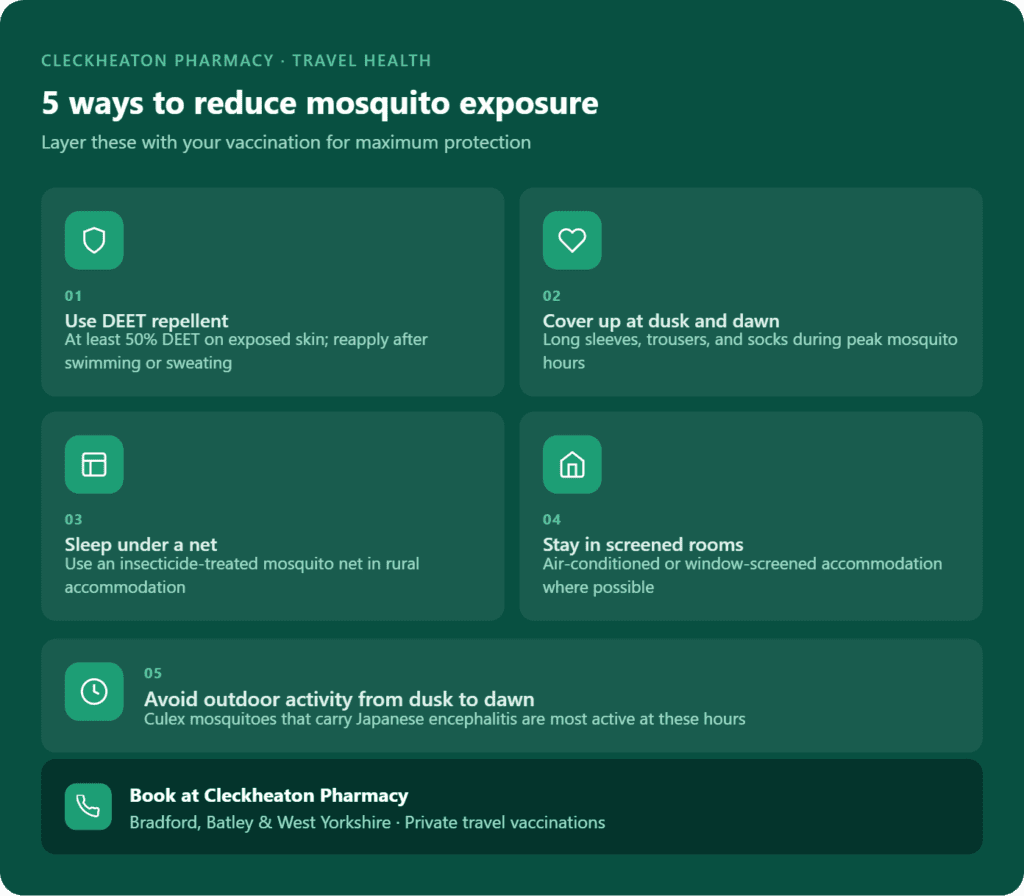
Vaccination is your primary protection, but layering it with practical bite-avoidance measures makes infection even less likely. The NHS recommends combining vaccination with:
- Insect repellent containing at least 50% DEET, applied to exposed skin and reapplied after swimming or sweating
- Long-sleeved clothing, trousers, and socks, particularly at dusk and dawn
- Sleeping under an insecticide-treated mosquito net in rural accommodation
- Avoiding outdoor activities during peak mosquito activity hours, dusk to dawn
- Staying in air-conditioned or screened accommodation where possible
Conclusion
Japanese encephalitis is rare for most UK holidaymakers, but for travellers spending significant time in rural Asia, vaccination is a straightforward and highly effective precaution. Two injections, a few weeks apart, and you are protected for up to two years. The process is quick, the side effects are mild for most people.
At Cleckheaton Pharmacy, we make it simple for patients across Bradford, Batley, and West Yorkshire to access travel vaccinations close to home. Book your japanese encephalitis vaccination at Cleckheaton Pharmacy today, and travel knowing you have done everything sensible to stay well.
FAQs
IXIARO® is not widely available outside the UK and parts of Asia. Getting vaccinated before departure is strongly advisable. If you are already overseas and concerned, contact a local travel clinic or your embassy for guidance, but supply cannot be guaranteed.
A short delay of a week or two is generally manageable. Contact us as soon as possible to reschedule. Both doses should ideally be completed well before potential exposure. Discuss your specific situation with our pharmacist for tailored advice.
Yes. It is approved from two months of age, with an adjusted dose for infants. Safety in pregnancy has not been fully established. Pregnant travellers should discuss their options with their GP or midwife before booking. Call us and we will advise on the best next step.
A full two-dose course provides protection for 12 to 24 months. If you are returning to endemic areas within that window, a single booster extends cover. Beyond 24 months, speak to us about whether a new primary course is appropriate.